
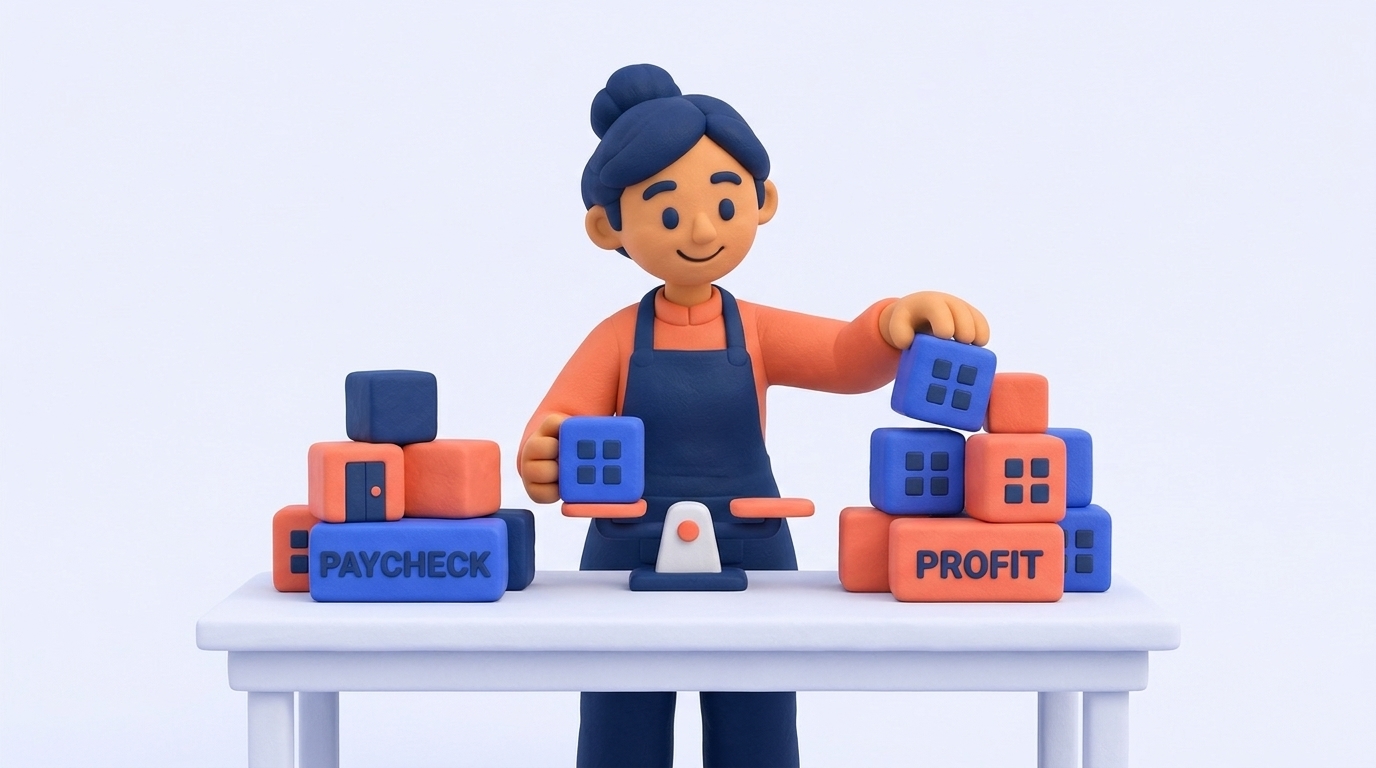
The IRS charges self-employment tax at 15.3% on net earnings, and that’s before regular income tax even enters the picture. For most owners, single member LLC taxes work this way by default. All your profit lands on your personal return and gets hit with that tax. An S corp election can shrink the amount subject to it. But it only works if you pay yourself a defensible “reasonable salary” and the savings beat the added costs. This guide walks through the mechanics, a labeled illustration, and the questions to take to your CPA.
Last updated: October 11, 2026
Key Takeaways
- A one-owner LLC is a “disregarded entity” by default. Profit flows to your Schedule C, and you generally owe self-employment (SE) tax on it.
- An S corp election splits profit into W-2 salary (payroll taxes apply) and distributions (no SE tax).
- The IRS requires reasonable compensation before you take distributions. There’s no fixed percentage.
- Payroll, a separate business return, and state costs can eat the savings, especially in a low-profit year.
- An S election doesn’t change your liability protection. That comes from state law.
How Single Member LLC Taxes Work by Default
Under the IRS’s entity classification rules (Treasury Regulation 301.7701-3, summarized on IRS.gov under “Single Member Limited Liability Companies”), a one-owner LLC that makes no election is a disregarded entity for income tax. In practice, that means:
- You report business income and expenses on Schedule C with your Form 1040.
- There’s no separate federal income tax return for the LLC.
- You pay tax on net profit whether or not you withdraw the money.
- You generally make quarterly estimated payments, per IRS Form 1040-ES guidance.
One exception: for employment tax purposes, the IRS treats a disregarded LLC as a separate entity if it has employees. That doesn’t change how your own SE tax works.
The Self-Employment Tax Burden
According to the IRS (Self-Employment Tax page and Schedule SE instructions), SE tax is 15.3% of net earnings. That’s 12.4% for Social Security up to the annual wage base, plus 2.9% for Medicare with no cap. The Social Security Administration adjusts the wage base each year, and the 2026 figure should be confirmed.
Net earnings are calculated on 92.35% of your Schedule C profit. An additional 0.9% Medicare tax can apply at higher incomes; check the current thresholds in the IRS Form 8959 instructions.
As Collective’s guide notes, you can deduct half of your SE tax when figuring income tax, which softens the impact. It doesn’t erase it.
That bite is why owners start asking about S corps. For a broader view of how structure affects your bill, see our overview of the tax implications of business incorporation.
Single Member LLC Taxes With an S Corp Election: What Changes
An S corp is a tax status, not a business type. According to the IRS, an eligible LLC can elect S corporation treatment by filing Form 2553 (Election by a Small Business Corporation). By filing it, the LLC is treated as a corporation for tax purposes and also takes S status.
Eligibility rules apply. The entity must be domestic, have no more than 100 shareholders, and have only one class of stock. There are also limits on who can be a shareholder (IRS, Instructions for Form 2553).
After the election, three things change:
- You become an employee. The IRS says officers who perform services are generally employees for employment tax purposes. So the company must run payroll, withhold taxes, and file payroll returns (Form 941, W-2s, state filings).
- The business files its own return. That’s Form 1120-S, with a K-1 issued to you. Profit passes through to your Form 1040.
- Profit splits in two. Salary is subject to FICA (Social Security and Medicare). The remaining profit, taken as distributions, isn’t subject to SE tax but is still subject to income tax.
Our guide to how an LLC and an S corp actually differ covers the bigger picture. This article stays on the tax math.
The Reasonable Salary Requirement
Here’s what most articles won’t tell you: the “just elect S corp” advice gets thin right here.
The IRS states that S corporation officers who provide more than minor services must receive reasonable compensation before non-wage distributions are made (IRS, “S Corporation Compensation and Medical Insurance Issues”). The agency looks at factors like training and experience, duties, time devoted, what comparable businesses pay for similar services, and compensation agreements.
There’s no fixed percentage.
Set your salary artificially low and the IRS can recharacterize distributions as wages. That means back taxes and penalties.
For ways owners actually pay themselves under each setup, see how to pay yourself as a business owner.
S Corp Savings Example: A Labeled Illustration
These numbers are hypothetical and simplified. They ignore the 92.35% adjustment, the income tax effect, the SE tax deduction, the Social Security wage base, and any state taxes. Your result will differ.
Assume $120,000 of net business profit and a reasonable salary of $70,000 for the work performed.
| Item | Default (disregarded LLC) | S corp election |
|---|---|---|
| Profit subject to payroll/SE tax | $120,000 | $70,000 (salary) |
| Approx. FICA/SE at 15.3% | $18,360 | $10,710 |
| Rough difference | — | ~$7,650 lower |
| Extra costs | None | Payroll service, 1120-S preparation, possible state fees |
The gap shrinks fast once you subtract added costs. Payroll software, a separate business return, and state-level charges can total a few thousand dollars. As MyIVA puts it, the payroll tax you’d save has to be more than the extra payroll and filing costs.
In a lower-profit year, the same election can cost more than it saves.
When an S Corp Election Might Pay Off
You won’t find one magic profit number. Treat these as questions for your CPA instead:
- Is my profit steady and well above a reasonable salary for my role? MyIVA suggests running the numbers once profit is consistently well above that level. If profit barely tops a defensible salary, there’s little left to distribute.
- What does a defensible salary look like for my industry and location? Ask your CPA to document it.
- What will compliance cost each year? Think payroll, the 1120-S, and state filings.
- How does the election affect my qualified business income (QBI) deduction? Salary reduces QBI, which can offset part of the savings. Confirm the deduction’s current status and limits for 2026 with the IRS (Form 8995 instructions).
- How does a lower salary affect retirement contributions and Social Security benefits? Retirement plan limits and benefit calculations are often tied to wages or SE earnings.
- Does my state tax S corps or LLCs at the entity level? See the state section below.
- Is the timing right? According to the IRS, Form 2553 generally must be filed no more than two months and 15 days after the start of the tax year the election takes effect. Late-election relief exists in some cases (IRS, Instructions for Form 2553; Rev. Proc. 2013-30). As of today, October 11, 2026, an election for 2026 is likely past the standard deadline unless relief applies, so a 2027 effective date is the more typical planning question.
White Coat Investor makes a similar point. CPAs may call the S corp an obvious choice, but the decision has more details than the headlines suggest.
What an S Corp Election Does Not Change
- Liability protection. It comes from the LLC (or corporation) under state law, not from the tax election. Check your state’s statute and Secretary of State guidance on keeping finances separate.
- Tax on your profit. Pass-through profit is still taxed on your personal return, whether you take it as salary or distribution.
- The need for clean records. Commingling funds or skipping payroll can undermine both your tax position and your liability protection.
Not sure which structure fits your situation? Our post on choosing the right business structure is a good starting point.
State Costs That Can Change the Math
Some states add costs no matter how the IRS treats you. For example, California imposes an annual minimum franchise tax and an LLC fee based on gross receipts on LLCs, and treats S corporations differently from the federal approach, according to the California Franchise Tax Board. Confirm the current fee schedule as of October 11, 2026.
Other states have their own entity-level taxes or may not recognize the S election the same way. Check your state tax agency and Secretary of State. You can also compare formation costs in our LLC filing fees by state breakdown.
What to Ask Your CPA or Attorney
- “Based on my last 12 months of profit, what would my total tax be under each setup, after payroll and filing costs?”
- “What salary can you support if the IRS asks, and how is it documented?”
- “How does this affect my QBI deduction and retirement plan options?”
- “What are my state’s entity-level taxes and filings?”
- “If my profit drops, can I revoke or change course, and what are the consequences?”
FAQ: Single Member LLC Taxes and S Corp Elections
Do single-member LLCs pay self-employment tax?
Generally yes. By default, net earnings from the business are subject to SE tax under IRS rules. An S corp election can change which portion of your income is subject to payroll taxes, but it brings payroll obligations.
How much profit do I need before an S corp makes sense?
There’s no IRS-set number. It depends on your reasonable salary, state taxes, and added administrative costs. As MyIVA notes, many advisors suggest running the numbers when profit is steadily well above a reasonable salary for your role. Have a CPA model your actual figures.
Can I pay myself a very low salary and take the rest as distributions?
No. The IRS requires reasonable compensation for services performed before non-wage distributions. It can recharacterize distributions as wages.
How do I elect S corp status for my LLC?
File Form 2553 with the IRS, subject to the eligibility and timing rules in the form instructions. An LLC electing S status is treated as having chosen corporate classification as well, per IRS guidance. Confirm the process with your tax professional.
Does an S corp election give me more liability protection?
No. Liability protection comes from the LLC or corporation under state law. The S election only affects federal tax treatment.
Your Next Step
Before you file anything, pull your last 12 months of net profit and write down what a reasonable salary for your role might be. Then read our guide to how an LLC and an S corp actually differ and bring both to your CPA meeting. Those two pieces of paper turn a vague question into a real number.
Disclaimer: The information in this article is for educational purposes only and does not constitute legal, tax, or financial advice. Business formation rules, fees, and deadlines vary by state and change often. Always consult a qualified attorney, CPA, or tax professional before making decisions about your business.